
Custom curtains come with a few terms that may be unfamiliar at first. Header styles, fullness, stack back, and curtain length all affect how your curtains look, fit, and function.
This glossary covers the essential terms you may encounter when measuring or ordering custom curtains.
1. Curtain Header Style
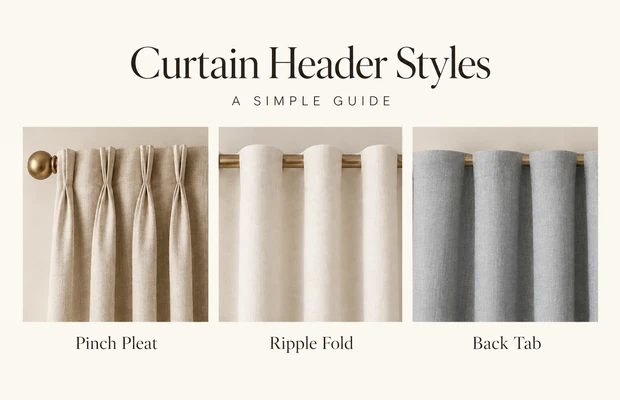
The header is the top section of the curtain that connects to the rod or track. It affects how the curtain hangs, how the folds are formed, and which hardware is required.
Grommet
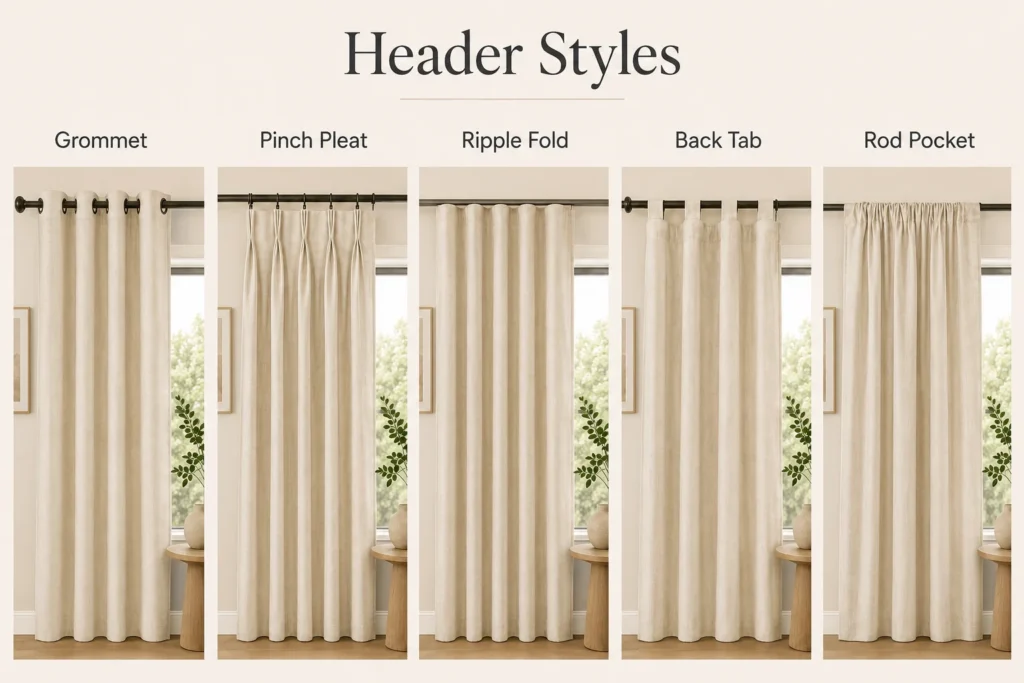
Grommet curtains have metal rings built into the top of the fabric. The rod passes directly through the rings, creating wide, relaxed folds. They are easy to open and close but require a visible curtain rod.
Pinch Pleat
Pinch pleat curtains are permanently gathered and stitched at the top. They create structured, tailored folds and are usually hung from hooks attached to rings or a compatible track.
Ripple Fold
Ripple fold curtains hang from a compatible track system and form evenly spaced, continuous S-shaped folds.
Because ripple fold construction depends on the track and carrier spacing, confirm hardware compatibility before ordering.
Rod Pocket
Rod pocket curtains have a sewn-in pocket along the top edge. The curtain rod slides directly through the pocket, creating soft, gathered folds.
Because the fabric fits closely around the rod, this style may not slide as smoothly as grommet curtains. It is best suited to windows where the curtains will remain mostly in place or be opened and closed only occasionally.
Back Tab
Back tab curtains have fabric loops sewn onto the back of the header. The rod passes through the hidden tabs, creating clean, evenly spaced folds while keeping the hardware mostly concealed.
Back tab curtains offer a more tailored appearance than rod pocket curtains but may not slide as smoothly as grommet curtains.
Browse DearDwell’s custom curtain collection to compare available fabrics and header options.
2. Curtain Fullness
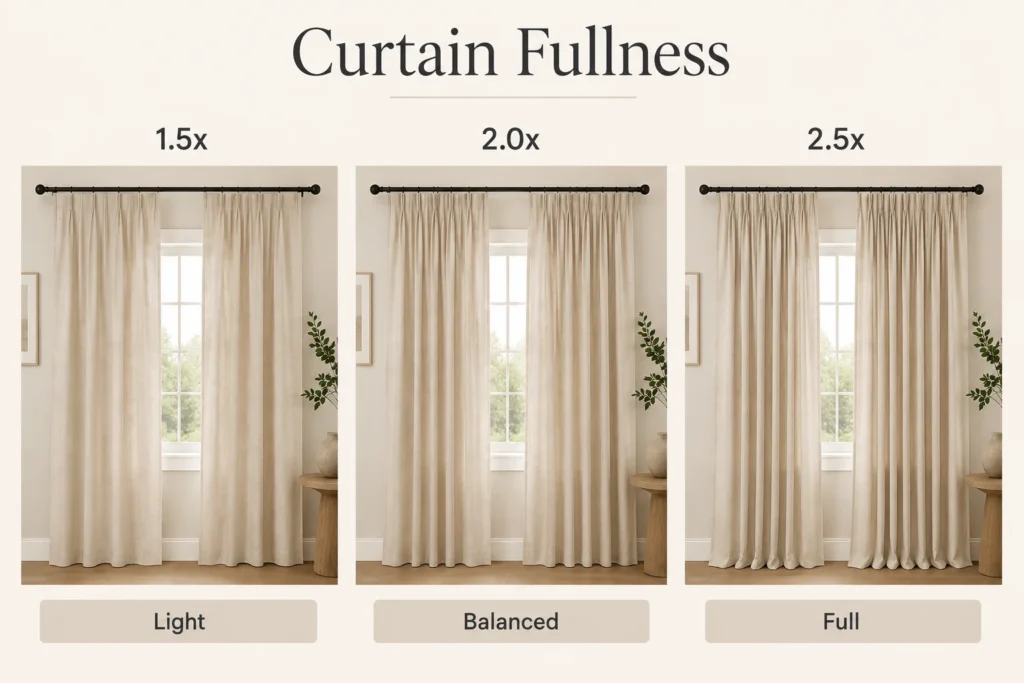
Curtain fullness describes how much fabric is used compared with the finished width of the installation.
More fabric creates deeper, more visible folds. Less fabric creates a flatter appearance. Common fullness levels generally range from approximately 1.5x to 2.5x, depending on the fabric and header style.
Sheers often use higher fullness for a softer, more gathered look. Heavier fabrics may need less fullness to avoid excessive bulk and a wider stack back.
Fullness requirements depend on the selected header style.
For structured styles with built-in fullness, such as pinch pleat and ripple fold, enter the actual rod or track width as instructed. Do not multiply the measurement by a fullness ratio, as the additional fabric is already included in the construction.
For soft-top styles, such as grommet, back tab, and rod pocket, multiply the usable rod width by your chosen fullness ratio to determine the total curtain width needed.
3. Finished Width, Panel Width, Rod Width, and Track Width
These measurements describe different parts of a curtain installation.
- Finished width is the total width the installed curtains are designed to cover.
- Panel width is the width of one individual curtain panel. In a split-panel arrangement, the total finished width is shared between two panels that meet in the center.
- Rod width is the usable span of the curtain rod, excluding decorative finials.
- Track width is the usable length of the curtain track.
The measurement required when ordering depends on the header style. Pinch pleat curtains typically use the usable rod width, while ripple fold curtains typically use the usable track width. Other header styles may require additional width to create the intended fullness.
See DearDwell’s How to Measure guide before entering your dimensions.
4. Stack Back
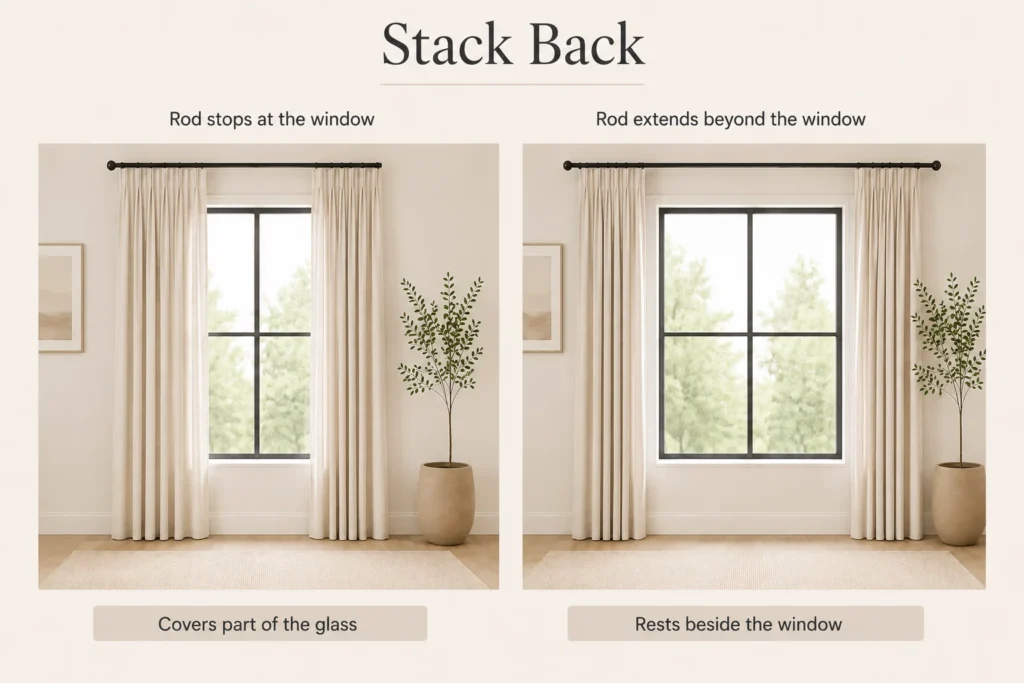
Stack back, sometimes called stack width, is the amount of space your curtains occupy when fully open.
Thicker fabrics, wider panels, and higher fullness usually create a larger stack back. Extending the rod or track beyond the window frame gives the gathered fabric more room to rest beside the glass instead of covering it.
The amount of extension needed depends on the fabric, fullness, panel width, and available wall space. As a general guide, we recommend allowing 6–15 inches of space on each side of the window so the curtains can stack back with minimal obstruction to natural light.
5. Drapery Return and Center Overlap
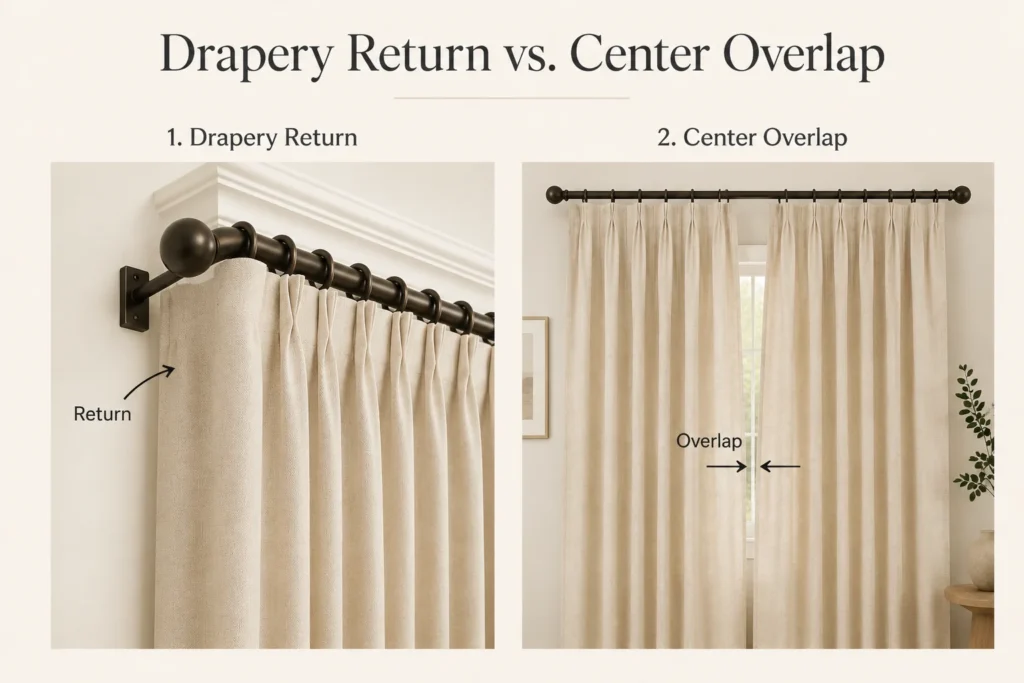
These two details can help reduce light gaps around a closed curtain.
Drapery Return
A drapery return is the outer section of the curtain that wraps from the front of the rod or track back toward the wall. It helps cover the side gap and reduce light entering around the outer edge.
The return width is usually based on the projection of the curtain rod or track from the wall.
Center Overlap
Center overlap describes how two center-draw panels meet or cross in the middle.
Depending on the hardware system, the overlap may be created by additional fabric, overlapping track carriers, or a dedicated overlap arm.
6. Curtain Length and Break
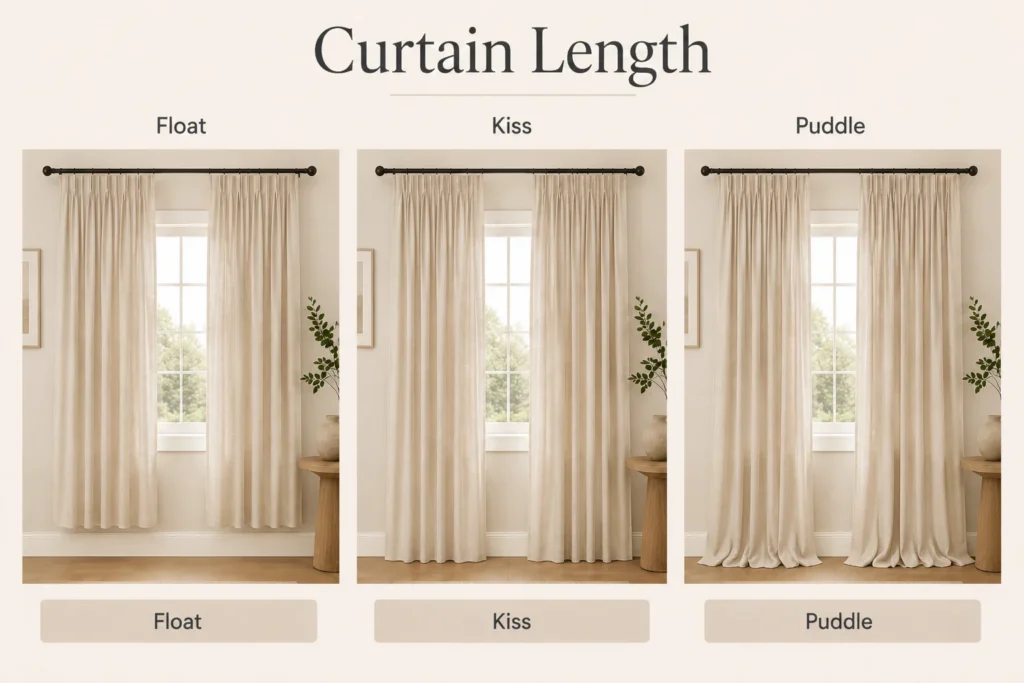
In curtain terminology, the “break” describes how the bottom hem meets the floor.
- Float: The curtain ends slightly above the floor, usually around 1/4 to 1/2 inch. This is practical for daily use and cleaning.
- Kiss: The hem just meets the floor without visibly pooling. This creates a clean, tailored appearance but requires careful measuring.
- Puddle: Several extra inches of fabric rest on the floor. This creates a softer, more dramatic look but is better suited to low-traffic rooms.
Use the How to Measure guide to calculate the correct order length for each finish.
7. Single Panel vs. Split Panels (Pair)
A single panel is one curtain panel that opens toward one side. It can work well for smaller windows, asymmetrical spaces, corner windows, or layouts with limited wall space on one side.
Split panels, also referred to as a pair, consist of two panels that meet in the center and open toward opposite sides.
This arrangement is commonly used for bedrooms, wide windows, and sliding glass doors.
When measuring split panels, follow the total-width instructions provided for your selected header style.
8. Sheers and Light-Control Levels
These terms describe different levels of privacy and light control.
Sheer
Sheers are lightweight, translucent panels that soften daylight and help reduce visibility from outside during the day.
They do not provide reliable nighttime privacy when interior lights are on. Browse DearDwell’s sheer curtain collection for lightweight layering options.
Light Filtering
Light-filtering curtains soften incoming sunlight while keeping the room bright.
Privacy varies depending on the fabric, color, and difference between indoor and outdoor lighting.
Room Darkening
Room-darkening curtains reduce a significant amount of incoming light but may still allow a soft glow through the fabric or around the edges.
Blackout
Blackout curtains are designed to block most or nearly all direct light through the fabric.
Blackout performance may come from the fabric itself, a coated backing, or a separate lining. The exact level varies by fabric and construction, so check the light-control description on each product page.
Some light may still enter around the sides, top, bottom, or center of the installation. Returns, center overlap, wider hardware, and floor-length coverage can improve overall light control.
A DearDwell Note
The measurement required depends on your selected header style. Always follow the instructions shown in the How to Measure guide and confirm that your rod or track is compatible before ordering.
Because fabric color, texture, and light control can look different in every room, we recommend ordering up to five fabric swatches through our Free Swatches program before purchasing full-size curtains.
For an unusual window, sliding door, or track system, contact DearDwell for help before placing your order.
Order Free Swatches View the Measuring Guide