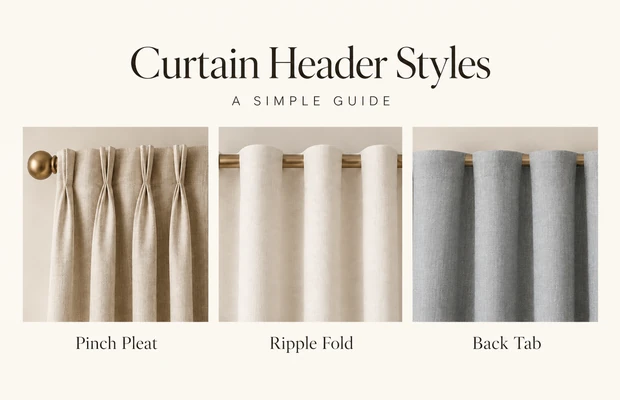

The same fabric can look quite different depending on the curtain header you choose. Sewn pleats give it a tailored shape, while softer gathers create a more relaxed feel. Your choice also affects how easily the curtains open and close, the hardware you’ll need, and how to measure their width.
This guide helps you compare the options and measure for your chosen style.
1. Curtain Header Styles: Compare the Look and Function
Start with the table below for a quick comparison, then explore each style in more detail. Consider both the look you prefer and how often you’ll open and close your curtains.
|
Header style | Aesthetic |
Best Suited For |
Hardware Compatibility |
|
Pinch/ Euro Pleat |
Elegant&tailored |
Living Rooms, Bedrooms | Rod with rings |
|
Inverted Box Pleat | Modern, Clean, Architectural |
Dining Rooms, Home Offices | Rod with rings |
| Back Tab | Relaxed, Soft, Understated | Bedrooms, Living Rooms | Standard Rods |
| Ripple Fold | Modern, Minimalist, Uniform | Living Rooms, Large Windows | Compatible Ripple Fold Tracks |
|
Grommet | Casual, Modern, Contemporary |
Media Rooms, Lounges | Standard Rods |
|
Rod Pocket |
Soft, Country, Traditional | Guest Rooms, Stationary Panels |
Standard Rods |

Pinch Pleat Curtains
Folds are sewn together just below the top edge for a classic, tailored finish. Choose double pleats for a lighter look or triple pleats for a fuller header.
Pros
- Fixed pleats keep the folds neatly defined.
- Easy to open and close with suitable rings or track carriers.
Cons
- The sewn header makes width adjustments difficult.
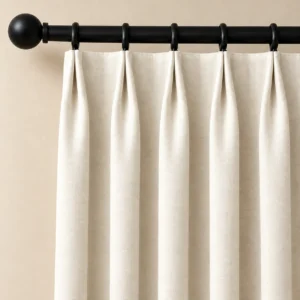
Tailored Pleat (Euro Pleat) Curtains
Pleats are sewn at the very top, allowing the folds to open softly below. The look is tailored but a little less formal than a classic pinch pleat.
Pros
- Creates a neat header with softer folds below.
- Works with rings or a compatible track.
Cons
- Changing the width usually requires altering the pleats.

Back Tab Curtains
Hidden fabric loops hold the curtain on the rod, creating soft, relaxed folds. The attachment stays out of sight for an uncluttered finish.
Pros
- No separate rings or hooks needed.
- Complements linen and other textured fabrics.
Cons
- Fabric tabs make frequent opening and closing less convenient.

Ripple Fold Curtains
A compatible track system holds the fabric in continuous, evenly spaced waves. The simple, flowing look works particularly well across wide windows.
Pros
- Maintains consistent waves as the curtains move.
- Glides smoothly on a compatible track.
Cons
- Requires a matching track and carrier system.

Grommet (Eyelet) Curtains
A rod passes through rings set into the header, forming broad, regular folds. The visible hardware adds a casual, contemporary detail.
Pros
- Easy to install on a suitable rod.
- Creates defined folds without separate hooks.
Cons
- Rings may make noise as they slide along the rod.

Rod Pocket Curtains
A sewn channel gathers the fabric around the rod for a soft, traditional look. It’s best suited to decorative panels that stay mostly in place.
Pros
- No separate rings or hooks needed.
- Conceals the rod within the gathered header.
Cons
- Fabric friction makes daily opening and closing less convenient.
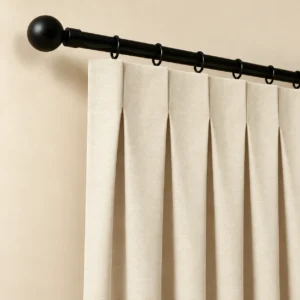
Inverted Box Pleat Curtains
Fabric folds inward behind the header, leaving a smooth face at the front. This creates a structured look that suits clean, understated interiors.
Pros
- Concealed pleats give the header a clean finish.
- Keeps patterns less interrupted across the top.
Cons
- Heavier fabrics can form a bulky stack when open.
2. How to Measure Width for Each Header Style
Curtain width depends on how the header forms its folds. Some styles are ordered by finished width, with fullness already built in; others need extra flat fabric width. Ripple fold measurements depend on the compatible track system.
2.1 Understanding Fullness Multipliers
Fullness refers to the amount of fabric used relative to the width your curtains need to cover. A higher fullness multiplier creates deeper, more generous folds, while a lower multiplier produces a flatter, more relaxed look.
For styles ordered by Flat Width, the calculation is:
Required Flat Width = Rod Width × Fullness Multiplier
For example, a 100-inch rod with 2× fullness requires 200 inches of combined flat curtain width, or two 100-inch panels for a center-opening pair.
However, not all header styles use this calculation. Pleated curtains typically have fullness built into their finished width, while Ripple Fold measurements depend on the track system.
2.2 Width Rules by Header Style
Finished Width vs. Flat Width
Before ordering custom curtains, it’s important to understand the difference between Finished Width and Flat Width.
- Finished Width is the width a curtain panel is designed to cover when hung, with its pleats or folds in place.
- Flat Width is the width of the curtain panel when laid flat, before any gathering or folds are formed.
Some header styles have fullness built into their construction, while others require additional fabric width to create natural folds. Ripple Fold follows a different approach, as its measurements depend on the compatible track system.
Styles with Built-In Fullness
Applies to: Pinch Pleat, Tailored Pleat (Euro Pleat), and Inverted Box Pleat.
These styles feature permanently sewn pleats, so the additional fabric needed to create fullness is already accounted for during production.
How to measure: Measure the width you want your curtains to cover and order that finished width. The manufacturer calculates the extra fabric required for the pleats.
For example, if your track is 100 inches wide, you would generally order a combined finished width of 100 inches, unless additional coverage is required by your installation.
Styles That Require Extra Width
Applies to: Grommet, Rod Pocket, and Back Tab.
Unlike sewn pleat styles, these curtains rely on extra fabric width to create their folds and gathers when hung.
How to measure: Measure your curtain rod width, then multiply it by the recommended fullness factor for your chosen style.
A fullness of 2× means using 200 inches of combined flat curtain width to cover a 100-inch rod.
The ideal fullness depends on the header style, fabric weight, and how gathered you want the curtains to look.
Ripple Fold: Track-Dependent Width
Ripple Fold curtains use a coordinated track and carrier system to create evenly spaced, continuous waves.
Unlike traditional sewn pleats or freely gathered curtains, the finished appearance depends on the spacing of the carriers, the fabric fullness, and the track system itself.
How to measure: Measure your intended track width and follow the curtain manufacturer’s specifications for the compatible Ripple Fold system.
Different systems may require different fabric allowances and ordering measurements, so a universal fullness multiplier should not be applied.
Always confirm track compatibility and measurement requirements before placing an order.
Quick Reference Summary Table
To help you visualize your order, use this cheat sheet based on a standard 100-inch wide curtain rod/track coverage (assuming a center-opening pair of two panels):
|
Header Style |
Required Fabric Fullness |
Total Width to Order (Combined) |
Individual Panel Width to Order (Qty: 2) |
Hardware Style Needed |
|
Pinch / Euro Pleat | Built-in (typically ~2×) | 100 inches (finished) | 50 inches |
Rod with Rings or Track |
|
Inverted Box Pleat | Built-in (typically ~2×) | 100 inches (finished) | 50 inches |
Rod with Rings or Track |
| Back Tab | 1.5×–2× (Gathered on rod) | 150–200 inches (flat) | 75–100 inches | Standard Curtain Rod |
| Ripple Fold | Track-dependent | Per Track System | Per Track System | Compatible Track |
|
Grommet |
1.8x – 2.0x (Gathered on rod) | 180 – 200 inches (flat) |
90 – 100 inches | Standard Curtain Rod |
|
Rod Pocket |
2.0x – 2.5x (Gathered on rod) | 200 – 250 inches (flat) |
100 – 125 inches |
Standard Curtain Rod |
3. Final Checks Before You Order
Confirm Your Hardware
Taking final measurements with your rod or track installed is the most reliable approach. If it isn’t installed yet, confirm its position and check where to measure from for your chosen header.
Allow Room for the Open Curtains
Curtains still take up space when pulled to the sides. This is called the stack back, and its width depends on the fabric, lining, fullness, and header style. If you want to keep the glass clear, allow enough space beside the window for the open panels.
Choose Your Length
Decide whether you want the curtains to sit just above the floor, touch it, or puddle slightly. A floor-clear finish is easier to keep clean and move, while extra length creates a softer look but needs more arranging.
Before ordering, confirm the hardware compatibility, whether the panel width is specified as finished or flat, and the measurement instructions for your chosen header. These details help you turn the look you like into the right fit for your window.
This guide covers a range of curtain header styles; DearDwell’s available options vary by fabric and collection. You’ll find the choices for each curtain on its product page.
Ready to take measurements? Follow our Measuring Guide, or browse our custom curtains to find a fabric you love.