

The Ultimate Custom Curtain Glossary & Buying Guide for Beginners

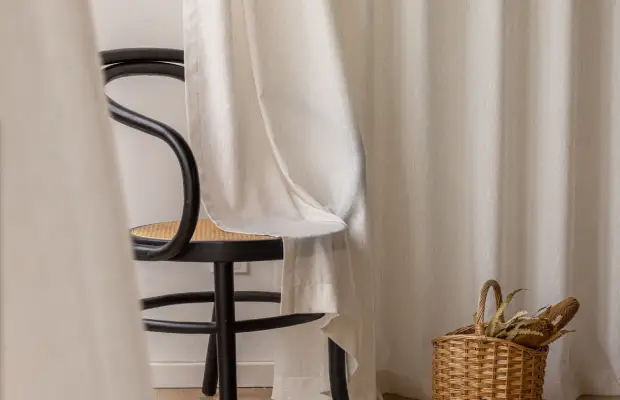
Shopping for custom window treatments can feel a bit like decoding a secret language. You just want beautiful drapes to make your home look cozy and finished, but suddenly you are hit with questions about fullness ratios, stack back widths, drapery returns, and fabric breaks.
If you get these wrong, your curtains might look like a flat bedsheet stretching across the window, or worse, they won’t block the light properly.
Don’t worry! At DearDwell, we believe dressing your windows should be exciting, not exhausting. To help you design your space with 100% confidence, we’ve put together the ultimate, jargon-free dictionary and FAQ guide that every first-time buyer needs.
The Expanded Curtain Glossary
To get exactly what you want, you need to know what to ask for. Here are the essential industry terms broken down into plain English.
1. Curtain Fullness (The secret to luxurious folds)
When you look at designer homes, the curtains never look like a flat sheet of fabric. They have rich, wavy folds. This bounce and dimension come from Fullness. Fullness is measured as a multiplier of your curtain rod’s width.
- 1.0x Fullness: The fabric width perfectly matches the rod width. When closed, it is completely flat. (Avoid this unless you want a visual flat screen).
- 2.0x Fullness (Standard Luxury): The fabric width is exactly double your rod width. This is the interior design sweet spot, creating beautiful, classic waves.
- 2.5x Fullness (Ultra-Premium/Sheers): The fabric is 2.5 times wider than the rod. This is highly recommended for lightweight linens or sheer fabrics to prevent them from looking sparse or flimsy.
2. Stack Back (or Stack Width)
When you open your curtains fully during the day, the fabric bunched up tightly on the sides of your window takes up space. That gathered block of fabric is called the Stack Back.
Pro Tip: If your curtain rod stops exactly at the edge of your window, the stack back will permanently block your glass, cutting off natural light and making your window look smaller.
3. Header Style
The Header is the very top section of the curtain panel that attaches to your hardware (rod or track). The header dictates the entire architectural vibe of the room and how smoothly the fabric glides.
- Grommet / Eyelet: Built-in metal rings that slide directly onto a rod. It offers a modern, relaxed, casual look.
- Pinch Pleat: Fabric is gathered, permanently pleated, and stitched at the top. This gives a highly tailored, traditional, and upscale look.
- Ripple Fold: Hangs from a specialized ceiling track to create uniform, continuous “S-curves” perfect for sleek, minimalist, or mid-century modern spaces.
4. Drapery Return (The light-blocking secret)
A Return is the distance from the front of your curtain rod back to the wall. When you hang curtains, there is naturally a gap between the fabric and the wall due to the mounting brackets. A “Drapery Return” means extending the outer edge of your curtain panel around the corner of the hardware to touch the wall directly. It wraps around the side of the rod to eliminate that annoying side-light halo, providing maximum darkness in bedrooms and keeping cold drafts out.
5. Overlap
When you have a pair of curtains (two panels meeting in the middle), the Overlap is the extra fabric built into the center edges so they cross over each other by an inch or two when closed. Without an overlap, your curtains will just sit edge-to-edge, leaving a glaring vertical crack of light right down the center of your room.
6. The “Break” (How your curtains meet the floor)
The Break refers to how the bottom hem of your curtain interacts with your flooring. It completely sets the tone of the room’s formality:
- Hover/Float (0.5 inches off the floor): Clean, modern, and highly functional. Ideal if you open and close your curtains daily or have pets (easier to vacuum!).
- Touching/Kissing (Exactly touching the floor): Requires highly precise measuring. It looks incredibly crisp and intentional, but leaves no room for error.
- Puddling/Pooling (2 to 6 inches of extra fabric on the floor): The fabric elegantly piles onto the floor. It creates a romantic, dramatic, ultra-luxurious bohemian or classic European feel, best suited for low-traffic rooms or sheer fabrics.
Frequently Asked Questions (FAQ)
Q: Why should my curtain rod be wider than my window frame?
This is the number one golden rule of interior design. You should always extend your curtain rod 6 to 12 inches (15–30 cm) past the window frame on each side.
There are two major reasons for this:
- Maximize Daylight: It allows the stack back of your curtains to rest completely on the wall, keeping 100% of the window glass clear when the curtains are pulled open.
- The Illusion of Size: It tricks the human eye into thinking your windows are massive, instantly elevating your room’s scale.
Q: Single Panel vs. Pair: Which should I choose?
- Pair (Split Draw): Two curtain panels of equal width that meet in the middle and open out to both sides. This is the traditional standard for large windows, sliding glass doors, and bedrooms.
- Single Panel (One-Way Draw): One wide curtain panel that pulls completely to one side (either left or right). This is perfect for smaller windows, corner windows where there is no wall space on one side, or asymmetric architectural layouts.
Q: What is the difference between Curtains, Drapes, and Sheers?
While people often use these words interchangeably, they are technically quite different:
- Sheers: Lightweight, translucent fabrics (like unlined faux-linen or voile) that diffuse sunlight, soften views, and maintain privacy during the day while letting light filter through.
- Curtains: Typically unlined or lightly lined fabric panels made from materials like cotton or blended linen. They offer casual privacy and light filtering.
- Drapes: Heavy-duty, lined panels made from substantial fabrics like velvet, heavy linen, or silk. They are structured, formal, and excellent for room darkening and thermal insulation.
Q: How do I choose between Linen and Velvet fabrics?
It all comes down to the mood and function of your room:
- Linen/Faux Linen: Casual, breezy, and organic. Linen allows natural light to filter beautifully (if unlined) and brings a relaxed, airy texture to living rooms, dining rooms, and coastal/scandinavian styles.
- Velvet: Rich, dramatic, and insulating. Velvet absorbs light beautifully, feels incredibly soft, and is fantastic for heavy light-blocking and sound-dampening. It’s the ultimate choice for cozy bedrooms, home theaters, and formal spaces.
Q: Should I choose a Blackout lining or a Privacy lining?
- Privacy / Room Light-Filtering Lining: This lets natural light softly glow through the fabric while ensuring no one can see into your home from the outside. Great for kitchens, home offices, and living rooms.
- Blackout Lining: A specialized thermal layer sewn behind the main fabric that blocks 95% to 100% of incoming light. This is an absolute must-have for bedrooms, nurseries, and night-shift workers who need to sleep during the day.
Q: Single Rod vs. Double Rod: What’s the benefit?
- Single Rod: Holds one set of curtains. Simple, minimalist, and cost-effective.
- Double Rod: Features a primary front rod and a secondary back rod mounted on the same bracket. This allows you to layer Sheers on the back rod (for daytime privacy) and Heavy Blackout Drapes on the front rod (for nighttime darkness). It gives you ultimate control over light and privacy 24/7.
Ready to Dress Your Windows?
Now that you speak fluent curtain jargon, measuring and ordering is a breeze. Browse DearDwell’s Premium Custom Curtain Builder, select your favorite textures, plug in your measurements, and let our craftsmen handle the math.
Still unsure about your unique window layout? Drop a message to our online design assistants—we’re always here to help you get the perfect fit!